

Choosing Between PAR56 and PAR64 LED Retrofits
February 3, 2026
How Many LED PAR Lamps Do You Really Need?
Lighting planning begins with understanding a space’s needs, as each environment uses lighting differently. Some rooms require broad, even illumination; others need controlled stage lighting; and some aim for dramatic accent lighting to highlight features.
The most common planning mistake is assuming that lighting quantity is determined only by square footage. In reality, the function of the space plays just as important a role as its size. A 30-foot room used for presentations may require a completely different lighting layout than a 30-foot stage used for performances.
This guide explains a practical approach to LED PAR lighting layout so you can estimate quantities confidently and avoid the common mistakes that delay purchasing decisions.
The Beam Angle Rule You Can’t Ignore
The beam angle describes how widely the light spreads after it leaves the fixture, and it directly affects how far apart lamps can be placed.
Narrow beams focus light into a smaller area. They produce strong intensity and long throw distances, which makes them useful for highlighting performers or directing light toward a specific target. However, because the beam is concentrated, more lamps are usually needed to achieve smooth coverage across a wider space.
Wide beams behave differently. They spread light over a larger area, creating broader illumination. This allows fixtures to be spaced farther apart, which often reduces the total number of lamps required.
Most LED PAR lighting systems use beam options such as 15°, 25°, 40°, or wide flood distributions. A 15-degree beam produces a tight, powerful spotlight. A 25-degree beam offers controlled directional lighting that works well for stage front wash. A 40-degree beam spreads light more generously and often provides balanced coverage for many venues. Wide flood beams distribute light broadly for ambient coverage when fixtures are mounted at lower heights.
The beam you choose determines how much overlap you need, how smooth the lighting will appear, and ultimately how many lamps must be installed.
Fixture Heights Are Critically Important
As the distance between the lamp and the surface increases, the beam spreads farther and the light intensity decreases.
Higher mounting heights usually require either tighter spacing or additional lamps to maintain consistent brightness. Lower mounting heights allow beams to overlap more easily, which often reduces the number of fixtures required.
For example, fixtures installed around twelve feet above the floor will illuminate a smaller area than those mounted at twenty feet. As the mounting height increases, more careful spacing is required to prevent uneven lighting. A lighting plan that works well at twelve feet may appear entirely different when installed at twenty feet.
A Spacing Approach That Works for Most Projects
When planning early estimates, a useful rule is to allow some overlap between beams so the light blends together rather than creating isolated pools of brightness. Overlap produces smoother coverage and reduces visible dark areas between fixtures.
In many stage and venue applications, spacing is often roughly half the distance between the fixture and the lit surface. This is not a strict rule, but it provides a reliable starting point for estimating lamp quantities.
For example, if fixtures are mounted fifteen feet above the stage, lamps spaced around seven feet apart often provide balanced coverage when using moderate beam angles. Wider beams may allow greater spacing, while narrow beams may require tighter placement.
Example: Lighting a Small Stage
Let’s look at a practical example. Imagine a stage that is about 24 feet wide, with lighting fixtures mounted roughly 14 feet above the performers. With a moderate beam angle such as 40°, spacing fixtures around 6–7 feet apart is usually a good starting point for estimating layout and coverage.
At that spacing, a basic stage layout might look like this:
- 4 lamps across the front will provide basic coverage of a 24-foot stage
- 5–6 lamps across will create smoother overlap and reduce shadows on faces
- 8+ lamps total may be used when adding backlighting or additional lighting angles for a more professional setup
Example: Lighting a Multipurpose Event Room
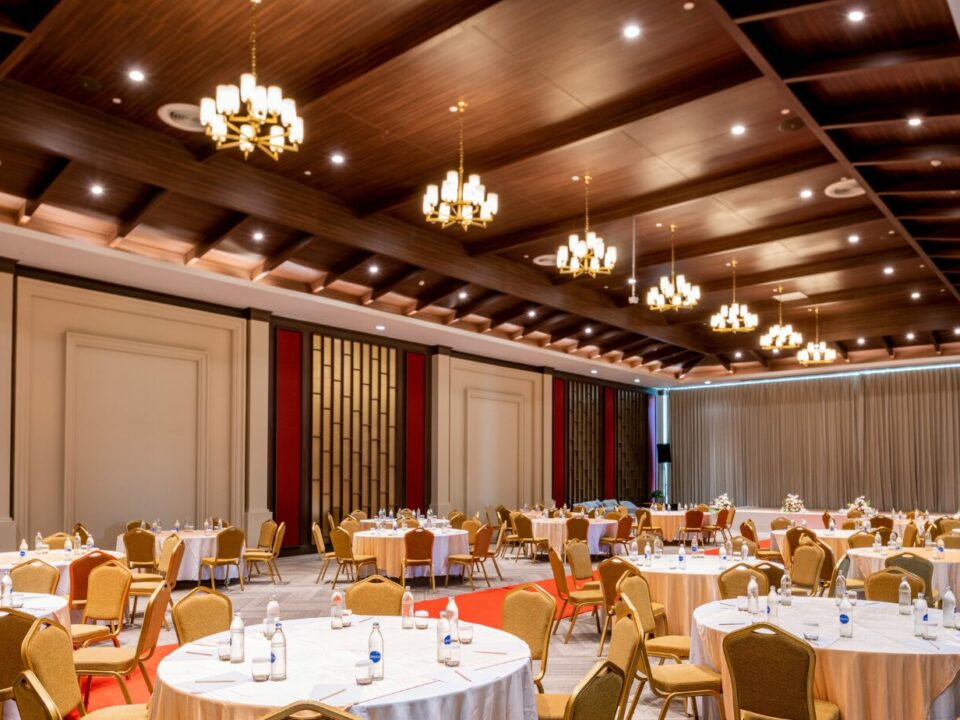
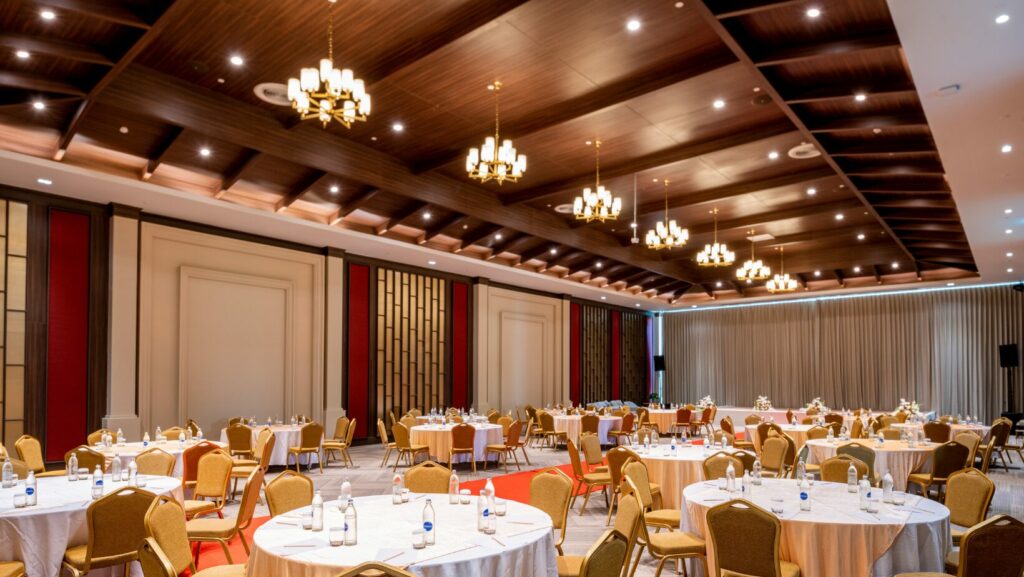
Now consider a larger multipurpose space, such as a 40 × 60-foot event room, with lighting fixtures mounted around 12 feet high. When the goal is general ambient lighting for meetings, banquets, or events, wider beam angles allow fixtures to be spaced farther apart while still maintaining balanced coverage.
Using spacing of roughly 10–12 feet, a typical layout might look like this:
- 4 fixtures across the 40-foot width of the room
- 5 fixtures along the 60-foot depth
- About 20 total LED PAR lamps to provide full-room coverage

People Always Forget About Underlighting
When planning lighting upgrades, many buyers try to minimize the number of fixtures to reduce upfront cost. While this approach seems logical, it often leads to uneven lighting and disappointment after installation.
Spaces that appear bright enough on paper can still feel dim or patchy when beams fail to overlap properly. This is especially noticeable on camera or during live events when shadows and inconsistencies become more visible.
Adding extra fixtures early on improves outcomes; expanding later is costly and disruptive. Experts recommend planning for slightly more coverage than the minimum.
Don’t Underestimate!
The right number of LED PAR lamps is simply the number needed to create smooth coverage, balanced brightness, and reliable performance across your space. That depends on the room size, mounting height, beam angle, and how the lighting will actually be used.
When those factors are planned correctly, there is no guesswork. You get consistent lighting, better visibility, and a system that performs exactly the way your venue needs it to.
A properly planned layout doesn’t just light a room; it improves presentations, enhances performances, and makes your space look more professional every time the lights turn on.
If you’re ready to upgrade your lighting, don’t wait until poor coverage slows you down.
Browse our LED PAR lamps and order now to get started!