

PAR Can Spacing Guide for Stages, Venues, and Event Rooms
March 4, 2026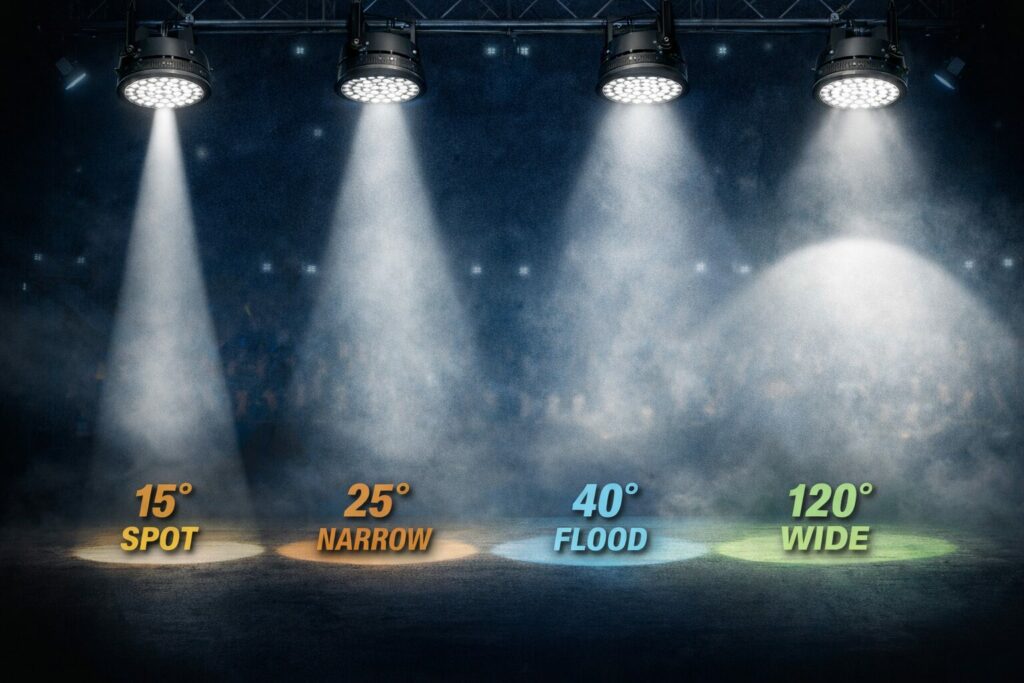
How To Get The Right Beam Angle for Your Space
Choosing the right LED PAR beam angle can make the difference between crisp, controlled stage lighting and a room that feels patchy, flat, or overlit. Buyers often focus on wattage first, but beam angle is what determines how the light actually behaves in the room.
It affects throw distance, stage lighting beam spread, fixture spacing, and how smooth the final result looks on people, walls, sets, and floors. On PAR LED Lights, the four available beam options are 15°, 25°, 40°, and 120°, each solving a different lighting problem.
Understanding how those optics behave in the real world helps buyers choose the right retrofit lamp with far more confidence.
What Beam Angle Really Changes
Beam angle describes how widely light spreads after it leaves the lamp. A narrow beam concentrates light into a smaller, more intense area. A wider beam spreads that same light over a broader area, softening the effect and increasing coverage.
Your own spacing guide makes this point clear: narrow beams deliver high intensity and longer throw, while wider beams create broader illumination and often allow fixtures to be spaced farther apart. It also notes that beam choice affects overlap, smoothness, and ultimately how many lamps may be needed.
As a rough visual, at a 20-foot throw, a 15° beam is about 5.3 feet wide, a 25° beam about 8.9 feet wide, and a 40° beam about 14.6 feet wide before you account for aiming, overlap, and usable brightness. That is why the same PAR can behave like a spotlight in one setup and a broad wash light in another.
15° Beam Angle
A 15° beam is the tightest optic in your catalog, and it is the right choice when you want concentrated light on a specific area instead of general coverage. This beam is ideal for tight front-of-stage throws, pulpit highlights, soloists, podiums, feature displays, or any application where you need punch and control more than spread.
Because the beam is narrow, it delivers more intensity to a smaller target area. This makes it a strong choice for longer throws and higher mounting positions where broad flood coverage would lose impact.
In many larger venues, buyers often pair this optic with PAR64 LED retrofit lamps when stronger output is needed.
25° Beam Angle
A 25° beam is often the sweet spot between spotlight control and practical stage coverage. It is narrow enough to keep light directed where you want it, but wide enough to avoid the overly tight look of a 15° beam in many everyday stage and presentation environments.
This angle is a strong fit for front wash on smaller stages, lecterns, presentation areas, retail accents, and platforms where the goal is coverage with control.
It also helps bridge a useful gap for buyers who think in “around 30°” terms, since the closest real SKU on the site is generally 25°.
40° Beam Angle
If a buyer is not sure where to start, 40° is often the safest answer. It gives broad enough coverage to create a smooth wash light, but still keeps enough directionality to feel intentional.
This makes it one of the most practical all-around choices for many stages, auditoriums, sanctuaries, event rooms, and multipurpose spaces.
For many customers, 40° is the best starting point when they want a flexible balance between control and coverage.
120° Beam Angle
A 120° optic is a completely different tool. It is best used for wide ambient coverage rather than focused stage illumination.
In real environments, 120° makes the most sense for low-height ambient lighting, wide room fill, lobby or event-space coverage, and situations where you want to minimize harsh hot spots.
At longer throws, though, it becomes too broad to deliver the same usable intensity and control as 15°, 25°, or 40°.
Beam Angle Alone Is Not Enough
One of the most common buying mistakes is choosing optics without thinking about fixture size and output. A perfect beam angle will still disappoint if the lamp family does not have enough output for the trim height, throw distance, or scale of the room.
Your PAR56 vs. PAR64 comparison article is useful here: PAR56 is framed as the better fit for general wash lighting, lower mounting heights, and applications where many fixtures create even coverage, while PAR64 is framed as the better fit for higher trims, longer throws, larger stages, and auditoriums where brightness at distance matters more.
So the decision is really two-part. First, choose the beam angle based on the kind of spread you want. Then choose PAR56 or PAR64 based on how much output the space needs.
A Simple Way to Choose the Right Beam Angle
Choose 15° when you need a tight spot, a long throw, or strong emphasis on a small target area.
Choose 25° when you want controlled stage wash, presentation lighting, or the closest real buying option to a “30-degree” concept.
Choose 40° when you want the most flexible all-around flood for stage wash, balanced overlap, and smoother coverage.
Choose 120° when your goal is wide ambient coverage at lower heights, not theatrical focus.
After that, choose the lamp family and connection style. Your beam-angle category currently breaks out into four products per optic, reflecting PAR56 and PAR64 in both GX16D and whip-connector versions. That structure makes it easy to move from lighting intent directly to the right SKU family.
Final Takeaway
The right PAR can optics are the optics that match the job. Tight front-of-stage throws and feature lighting call for narrower beams. Smooth platform wash usually benefits from a moderate flood. Broad ambient coverage needs a wide flood.
When buyers understand that beam angle controls how the light behaves in the space, they make better decisions, get better results, and are far less likely to end up with dark gaps, harsh hot spots, or wasted output.
On your site, that buying path is straightforward: start with 15°, 25°, 40°, or 120°, then choose PAR56 or PAR64 based on fixture size, output needs, and connection style.